Trampolines Best picks
Best Springless Trampolines (2026): Four Sizes Ranked, and What the Design Costs You
Springless means the two hardest objects on a trampoline, the coil springs and the frame rail, are not where a child falls. One brand has US stock in four sizes right now. Here is how to pick the size, and the number the design gives up.
We may earn a commission when you buy through links on this page, at no extra cost to you. It never decides the ranking: the scoring method is published. How we're funded
Quick picks
The short answer
| # | Product | Best for | Score | Price |
|---|---|---|---|---|
| 1 | 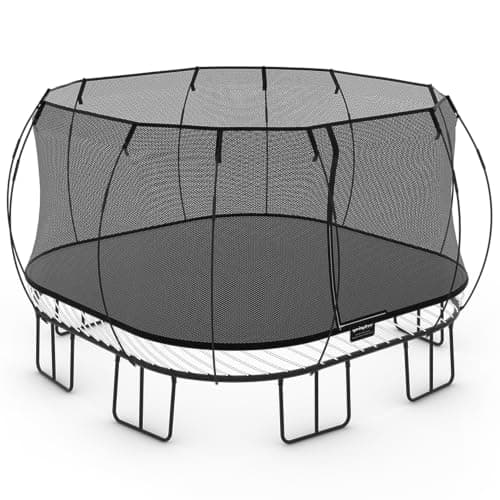 Springfree Jumbo Square Trampoline (S155) The biggest mat in the range at 155 sq ft, with composite rods under the jumping surface, the SoftEdge mat, a FlexiNet on flexible rods and 10 years on every part. It wants a 23 x 23 ft site. | Best springless trampoline overall | 8.2 / 10 | Check price on Amazon |
| 2 | 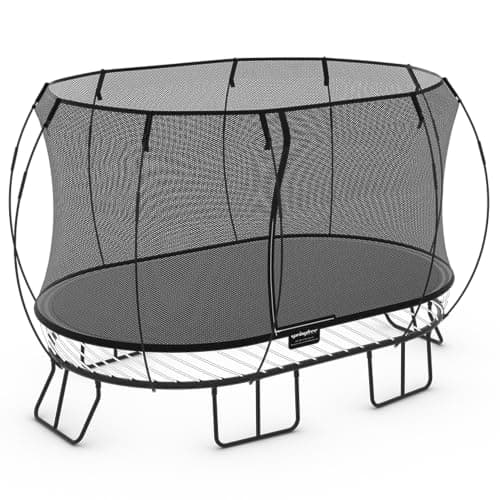 Springfree Large Oval Trampoline (O92) An 8 x 13 ft mat that fits a published 18 x 23 ft space, which is the shape most long, narrow lawns actually have. Same rods, same net, same 10-year warranty. | Best springless trampoline for a narrow yard | 8.2 / 10 | $1,849.00Amazon |
| 3 | Springfree Medium Round Trampoline (R79) A 10 ft round mat in a 20 x 20 ft site: the smallest full-size springless frame, with nothing given up on the edge design. | Best springless round for a normal lawn | 8.2 / 10 | Check price on Amazon |
| 4 | Springfree Compact Round Trampoline (R54) An 8 x 8 ft mat, 7 ft 7 in tall, delivered in two boxes of 76 and 75 lb. The single-jumper limit drops to 175 lb, which is the trade for the smallest frame. | Best springless trampoline for young children | 7.8 / 10 | Check price on Amazon |
#ad · Prices come live from Amazon, last checked November 2, 2026. Scores are ours, built from published specs, manuals and warranty terms on a rubric we publish. Product photos come from Amazon; a pick we have no photo for shows none. Tap a row for the full write-up.
What springless actually means
On a conventional trampoline the two hardest things a falling child can reach are the coil springs and the steel frame rail, and both of them sit at the rim of the jumping surface, directly under the pad. Everything the category does about safety is an attempt to manage that: thicker pads, nets that clip to the mat, poles that curve away. Springless design removes the problem instead of covering it.
There are two ways to do it, and they are genuinely different engineering. Composite rods beneath the mat is Springfree's patented approach: flexible glass-reinforced rods run under the jumping surface, so the bounce comes from below rather than from coils at the edge, and the frame is hidden below jumping height. Leaf springs is Vuly's approach on the Thunder: pre-curved compact leaf springs with no welds or rivets replace the coils, tucked under the mat line rather than sitting in the fall path.
Both get you to the same place at the edge, and that is why springless frames take the two highest enclosure scores on this site. Our trampolines rubric gives enclosure and edge design 30 percent, more than any other metric (how we rate), and Springfree is the only product in the registry scoring a 10 on it. If you want the full version of that argument rather than the ranking, it is on Springfree vs spring trampolines, and the narrower question of where a net should attach is on trampoline net inside or outside the springs.
One thing springless does not do is remove the need for supervision. The American Academy of Pediatrics discourages home trampolines generally, and CPSC's guidance on one jumper at a time, no somersaults and a level site clear of structures and trees applies to a springless frame exactly as it does to a coil-spring one. Most trampoline injuries happen on the mat, not at the edge, and no amount of engineering addresses two children colliding (how many kids can jump on a trampoline).
How we ranked these
The four frames below are the same design in four sizes, so the ranking is not really a quality ranking: it is a size-and-site ranking, settled on the published rubric in this order.
Edge and enclosure design (30 percent). Identical across the range: rods under the mat, no rigid pole at jumping height, SoftEdge mat, FlexiNet. All four score the same here, which is the point of buying springless at all.
Rated capacity and structure (20 percent). This is where the range separates. Springfree publishes a 220 lb single-jumper capacity and a 1,500 lb tested maximum on the full-size models, and 175 lb with a 1,300 lb tested maximum on the R54. A published per-jumper figure is worth more than a four-figure structural number, and we score it that way (trampoline weight limits).
Anchoring provision (20 percent). The weakest row for every springless frame here: the Ground Anchor kit is a separate purchase, four anchors for standard models and eight for the Jumbo. Budget for it on the same order, because a frame this size is a sail in a storm (best trampoline anchors, how to anchor a trampoline).
Certification (15 percent). Springfree names ASTM F2225 and F381 by designation, which is more specific than the built-to-ASTM line most of the market uses, and it is one of the reasons the brand scores as well as it does on paper.
Install reality (15 percent). Published assembly guidance, parts availability and warranty length. Ten years on all parts is the longest all-parts warranty in the registry, and the R54 is the only model in the range that publishes its box count and per-box weights.
Honest cons apply to every pick on this page and they are the same three: the anchor kit is extra, the single-jumper limit is lower than several coil frames, and the site each model needs is much larger than the mat (how much space for a trampoline).
Size, space and limit, side by side
| Model | Jumping mat | Site required | Single jumper | Warranty |
|---|---|---|---|---|
| Jumbo Square (S155) | 13 x 13 ft; 155 sq ft | 23 x 23 ft, including 5 ft a side | 220 lb (1,500 lb tested) | 10 years, all parts |
| Large Oval (O92) | 8 x 13 ft; 92 sq ft | 18 x 23 ft | 220 lb (1,500 lb tested) | 10 years, all parts |
| Medium Round (R79) | 10 x 10 ft; 79 sq ft | 20 x 20 ft | 220 lb (1,500 lb tested) | 10 years, all parts |
| Compact Round (R54) | 8 x 8 ft; 54 sq ft | 18 x 18 ft | 175 lb (1,300 lb tested) | 10 years, all parts |
As published by Springfree; the sourced spec cards are below. Note the gap between mat and site: the S155 needs more than four times its own mat area in clear ground, which is the single most common reason a springless trampoline does not fit the yard a buyer had in mind.
The number springless gives up
If you read one paragraph before buying, read this one. Springfree's published single-jumper capacity is 220 lb, and it does not rise with frame size: the 13 x 13 ft Jumbo Square and the 10 ft round carry the same figure, and the R54 drops to 175 lb. Several coil-spring frames publish more: the Jumpflex HERO publishes 350 lb per user inside a 550 lb total, the ACON 16 HD publishes a CE and ASTM-certified 330 lb, and Skywalker publishes a recommended 275 lb individual limit on its 15 and 16 ft rounds.
So the trade is explicit. If the trampoline is for children, 220 lb is far more headroom than you need and the springless edge is the best safety buy in the category. If a 200 lb adult intends to use it regularly, or a teenager is heading that way, a springless Springfree is at or near its published ceiling and a coil frame with a bigger printed number is the honest recommendation (best trampolines for adults). That is a capacity decision rather than a safety one, and the two get conflated constantly.
The other cost is the site. Every model needs 18 to 23 ft of clear, level ground, which is more than many suburban lawns have once a fence, a tree and a patio are accounted for. Measure the circle or rectangle on the ground with a tape before you order, and check the overhead line as well: the S155 stands 9 ft 4 in and the R54 7 ft 7 in before anyone is on them. If the ground falls away more than a few inches across the site, fix the ground first (trampoline on a slope), and decide what goes underneath while you are at it (what to put under a trampoline).
The rest of the springless field
The springless category is smaller than its marketing presence suggests, and right now it is effectively one brand with US stock. We checked both ranges on 21 October 2026 before writing this page.
Springfree lists ten models in its US store, with the four in this ranking shown in stock and the Jumbo Square flagged as low inventory. That is why all four picks here are Springfree: they are the springless frames you can actually order today.
Vuly builds the other genuine springless design, the leaf-spring Thunder, and on paper it is the strongest springless frame for heavier jumpers: a published 330 lb maximum user weight, a net Vuly rates at a zero-inch gap to the mat under 220 lb of static load, a self-sealing door and AS4989:2015 plus three EN71 parts named by designation. We have not ranked it here because every size of the Thunder and the coil-spring Ultra showed no stock in Vuly's US store on the date above. If Vuly restocks, it belongs on this page, and the brand comparison is already written up on Springfree vs Vuly and the Vuly review.
Everything else sold as springless is usually something adjacent: a bungee-cord rebounder for adult fitness, which is a different machine entirely (trampoline vs rebounder), or a conventional frame whose net happens to sit inside the springs. A net inside the coils is a real improvement and it is not the same thing as having no coils (best trampolines with an enclosure net).
An in-ground installation is the other way to attack the same hazard from a different angle: it removes the fall height rather than the springs, and the better kits bundle the retaining wall and a vented pad (best in-ground trampoline kits, Springfree vs BERG).
Who should not buy springless
Three groups, plainly. Households where an adult will be the main jumper: the published capacity is against you, and a rectangle with a certified 330 lb limit is the better machine. Buyers whose flat ground is under about 18 ft across: the clearance requirement is not negotiable, and a smaller coil frame in a properly clear site is safer than a springless frame crammed against a fence. Anyone whose real constraint is the budget bracket: springless sits at the top of this market, and the entry tier buys a coil frame with a mat-attached net instead, which is a genuinely good safety outcome for the money (best trampolines under 300 dollars).
In detail
Every pick, in full
1
Best springless trampoline overall
Springfree Jumbo Square Trampoline (S155)
Scored on the trampolines rubric
The biggest mat in the range at 155 sq ft, with composite rods under the jumping surface, the SoftEdge mat, a FlexiNet on flexible rods and 10 years on every part. It wants a 23 x 23 ft site.
Published specs (tap for source)
- Enclosure & edge design (30%)
- 10
- Anchoring provision (20%)
- 6
- Rated capacity & structure (20%)
- 7
- Certification & standards (15%)
- 9
- Install reality (15%)
- 8
Why we picked it
- Springs, rigid poles and the frame edge are all moved out of the jumping zone by design
- 10-year warranty on every part, the longest all-parts coverage here
- Mat area equivalent to a 15 ft round in a 13 x 13 footprint
Worth knowing
- 220 lb single-jumper limit is below the Jumpflex HERO and Acon 16 HD
- Ground anchors are an extra purchase and Jumbo models need 8
- Premium price tier; often sold through Costco and dealers rather than Amazon
Skip it if…
…adults over 220 lb will use it; the springless design does not raise the single-jumper limit.
#ad · Price as of November 2, 2026 · Affiliate disclosure for the link to Springfree Jumbo Square Trampoline (S155)
2
Best springless trampoline for a narrow yard
Springfree Large Oval Trampoline (O92)
Scored on the trampolines rubric
An 8 x 13 ft mat that fits a published 18 x 23 ft space, which is the shape most long, narrow lawns actually have. Same rods, same net, same 10-year warranty.
Published specs (tap for source)
- Enclosure & edge design (30%)
- 10
- Anchoring provision (20%)
- 6
- Rated capacity & structure (20%)
- 7
- Certification & standards (15%)
- 9
- Install reality (15%)
- 8
Why we picked it
- Fits a long, narrow lawn
- Same springless edge design as the S155
- 10-year all-parts warranty
Worth knowing
- 92 sq ft mat is small for the money
- 220 lb single-jumper limit
- Anchors sold separately
Skip it if…
…you have the width for the Jumbo Square; the oval gives up 63 sq ft of mat.
#ad · Price as of November 2, 2026 · Affiliate disclosure for the link to Springfree Large Oval Trampoline (O92)
3
Best springless round for a normal lawn
Springfree Medium Round Trampoline (R79)
Scored on the trampolines rubric
A 10 ft round mat in a 20 x 20 ft site: the smallest full-size springless frame, with nothing given up on the edge design.
Published specs (tap for source)
- Enclosure & edge design (30%)
- 10
- Anchoring provision (20%)
- 6
- Rated capacity & structure (20%)
- 7
- Certification & standards (15%)
- 9
- Install reality (15%)
- 8
Why we picked it
- Springless edge in the smallest footprint Springfree makes
- 10-year all-parts warranty
Worth knowing
- Only 79 sq ft of mat
- 220 lb single-jumper limit
- Anchors extra
Skip it if…
…two kids will want to jump; the 10 ft mat is a one-at-a-time surface.
#ad · Price as of November 2, 2026 · Affiliate disclosure for the link to Springfree Medium Round Trampoline (R79)
4
Best springless trampoline for young children
Springfree Compact Round Trampoline (R54)
Scored on the trampolines rubric
An 8 x 8 ft mat, 7 ft 7 in tall, delivered in two boxes of 76 and 75 lb. The single-jumper limit drops to 175 lb, which is the trade for the smallest frame.
Published specs (tap for source)
- Enclosure & edge design (30%)
- 10
- Anchoring provision (20%)
- 6
- Rated capacity & structure (20%)
- 5
- Certification & standards (15%)
- 9
- Install reality (15%)
- 8
Why we picked it
- Same springless edge design as the models costing twice as much
- Published space requirement of 18 x 18 ft, which is the smallest Springfree footprint with a full enclosure
- 10-year warranty on every part
Worth knowing
- 175 lb single-jumper limit, the lowest in the Springfree range
- 54 sq ft of mat is small once a child is nine or ten
- Ground anchors are a separate purchase, as on every Springfree
Skip it if…
…a teenager or an adult will use it; the 175 lb limit rules that out before the mat size does.
#ad · Price as of November 2, 2026 · Affiliate disclosure for the link to Springfree Compact Round Trampoline (R54)
What to look for in a springless trampoline
How the springs were actually removed. Rods under the mat or leaf springs under the mat line, not a conventional coil frame with a better net. Where the frame sits. Below jumping height, so a fall cannot reach the rail. What the enclosure stands on. Flexible rods or outward-curving poles, never a rigid padded tube at shoulder height. A published single-jumper limit. Not just a four-figure tested maximum. The site requirement, in feet. Springfree publishes it for every model; use that number, not the mat size. Warranty by part. Ten years on all parts is the benchmark this brand set; most of the market splits frame, mat, pad and net into four different numbers. What the anchor kit costs. It is extra on every model here.
What ownership is actually like
The maintenance list is shorter than a coil frame's because there is no spring row to inspect and no pad over the springs to split in the sun, but it is not empty. The FlexiNet, the mat and the rods are all replaceable parts, and Springfree sells them against the model code, which is the reason the brand's install-reality score holds up: a ten-year-old frame is still a repairable frame. Walk the net every spring, check that the mat is not fraying at the rod sockets, and look at the ground contact for movement (when to replace a trampoline mat and net).
Two practical notes from the documentation. Springfree branches its manuals by model code and serial-number letter, and it warns that the QR code printed in the manual in the first box may be incorrect, so work from the support site rather than the sticker (Springfree trampoline manuals). And the frames arrive in multiple boxes: the R54 ships as two boxes at 76 and 75 lb, so a springless delivery is a two-person job at the kerb before it is an assembly job (how much a trampoline weighs).
If springless is not the answer
The next best thing for edge safety is a coil frame whose net is sewn or clipped to the jumping mat, which keeps the springs outside the enclosure: Zupapa sews net and mat together, Jumpflex clips its net down for the full 360 degrees, and Skywalker buttons the net to the mat at every spring. Those are ranked at every size on best trampolines, best 14ft trampolines and best 15ft trampolines, and the brand-level view is on best trampoline brands.
How we picked
Why these picks made the list
Every pick is scored from the maker's published specs, manual and warranty terms on a safety rubric we publish (net and edge design, anchoring, rated capacity, standards, install reality), and the sources behind each number are listed at the bottom of the page.
Scores are our editorial judgment of that published information. Nobody pays for placement, and an unpublished spec is never guessed upward. See every rubric and weight.
Trampolines rubric
- Enclosure & edge design
- 30%
- Anchoring provision
- 20%
- Rated capacity & structure
- 20%
- Certification & standards
- 15%
- Install reality
- 15%
FAQ
Questions parents ask
What is the best springless trampoline?
Are springless trampolines safer?
What is the weight limit on a springless trampoline?
Which brands make springless trampolines?
Do springless trampolines need anchoring?
How much space does a springless trampoline need?
Is a springless trampoline worth the extra money?
Related
Keep reading
- Springfree vs spring trampolinesThe design argument in full.
- Springfree trampoline reviewThe brand in detail.
- Springfree vs BERGSpringless above ground against in-ground springs.
- Springfree vs VulyThe two springless designs compared.
- Best trampolines with an enclosure netThe coil-frame alternative.
- How much space for a trampolineWhy the site is bigger than the mat.
Update log
What changed
- First published.
Receipts
Sources
- 1.Springfree Trampoline US store: trampoline range, models and stated availability (checked Oct 21, 2026)
- 2.Vuly Play USA: Thunder product page, sizes and stock status (checked Oct 21, 2026)
- 3.CPSC Publication 085, Trampoline Safety (PDF; fetched Sep 22, 2026)
- 4.American Academy of Pediatrics policy statement, Trampoline Safety in Childhood and Adolescence, Pediatrics 2012;130(4):774-779
Capacities, materials, anchoring provisions and warranty terms come from the maker's own listings and manuals (or a named retailer's listing where the maker doesn't publish them). Safety guidance is linked to CPSC, the AAP, ASTM or the study it came from. Buy buttons open the live Amazon listing, so you always see today's price. Read the full method.