Trampolines Guide
Are Trampolines Safe for Kids? What CPSC, the AAP and the Hospital Data Say
The AAP says home trampolines are strongly discouraged. CPSC says no child under 6 and one jumper at a time. The hospital data says most serious injuries are fractures in 5-14 year olds. Here is all three, quoted, and what a parent who buys one anyway should do.
We may earn a commission when you buy through links on this page, at no extra cost to you. It never decides the ranking: the scoring method is published. How we're funded
What CPSC says
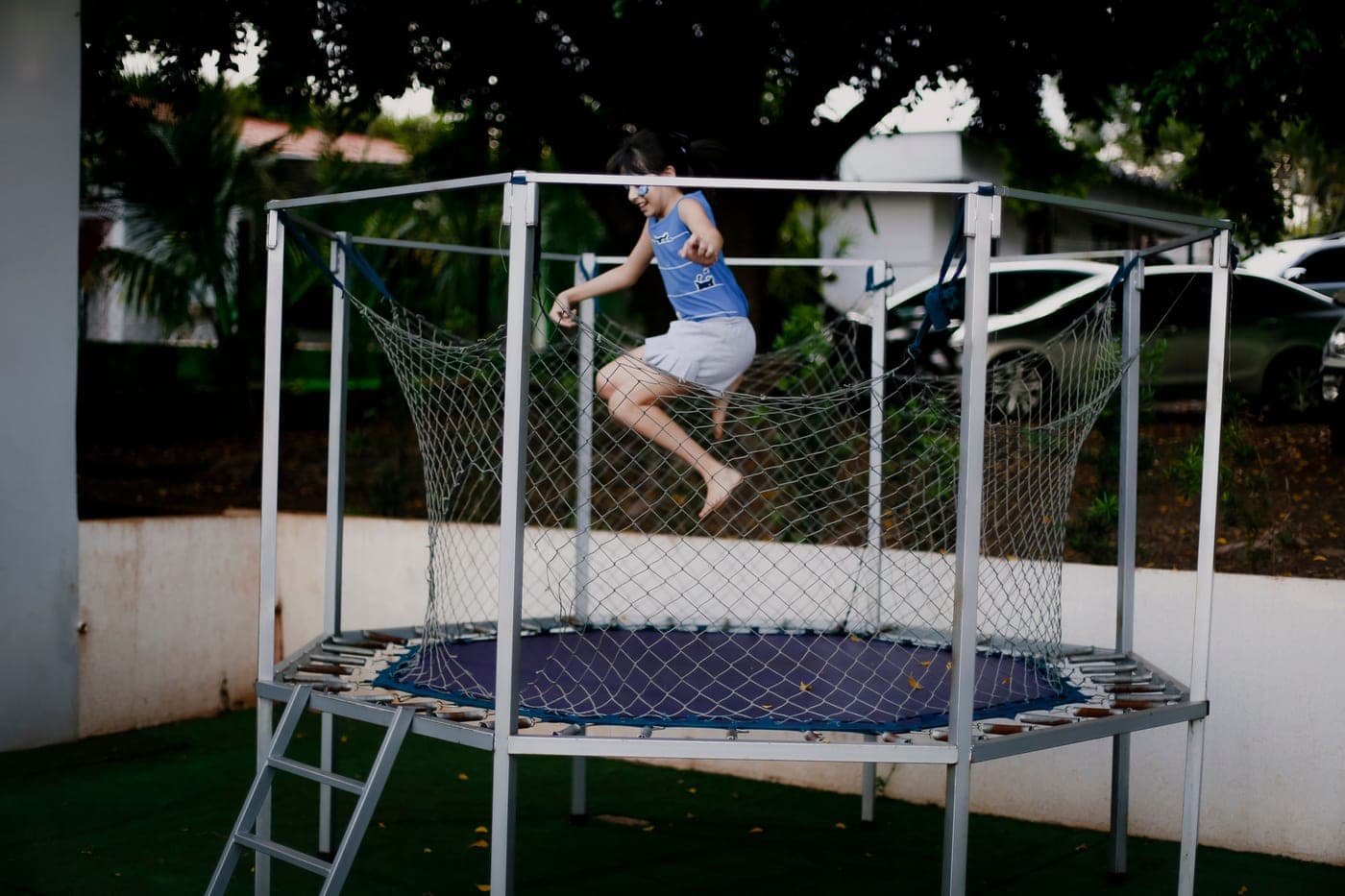
CPSC Publication 085 lists the causes of trampoline injuries and deaths as colliding with another person on the trampoline, landing improperly while jumping or doing stunts, falling or jumping off, and falling on the springs or frame. Its steps, quoted: "Allow only one person on the trampoline at a time." "Do not attempt or allow somersaults, because landing on the head or neck can cause paralysis." "Do not use the trampoline without shock-absorbing pads that completely cover its springs, hooks and frame." "Place the trampoline away from structures, trees and other play areas." "No child under 6 years of age should use a full-size trampoline. Do not use a ladder with the trampoline, because it provides unsupervised access by small children." "Always supervise children who use a trampoline." "Trampoline enclosures can help prevent injuries from falls off trampolines." The same publication estimates 104,691 emergency-room-treated trampoline injuries in 2014 and 22 deaths from 2000 to 2009.
What the AAP says
The AAP's 2012 policy statement, Trampoline Safety in Childhood and Adolescence, updates earlier statements that already discouraged home use. Its abstract: "Most trampoline injuries occur with multiple simultaneous users on the mat. Cervical spine injuries often occur with falls off the trampoline or with attempts at somersaults or flips. Studies on the efficacy of trampoline safety measures are reviewed, and although there is a paucity of data, current implementation of safety measures have not appeared to mitigate risk substantially. Therefore, the home use of trampolines is strongly discouraged." That is the pediatricians' position, and this site does not soften it.
What the hospital data says
The most recent national study we found, Totapally and colleagues in Cureus (December 2024), analyzed U.S. pediatric hospital discharges for 2019: 885 trampoline-related hospitalizations, 41.3 per 100,000 pediatric discharges, against an estimated 108,542 emergency department visits for children 0-20 (about 0.82% of ED visits led to admission). Of those hospitalized, 40.1% had upper-limb fractures and 31.2% lower-limb fractures; 13.2% had serious injuries (intracranial, spinal, abdominal or paralysis), including 8.2% intracranial injury and 2.4% spinal cord injury. Ages 5-9 made up 38.7% of admissions and 10-14 another 28.0%; 59.9% were boys; 75.4% needed an orthopedic operation. The full breakdown is on trampoline injury statistics.
By age: 2, 3, 4, 5, 10
Ages 2-5. CPSC: no full-size trampoline under 6. That covers every product on this site. The smallest child on a mat with a bigger one is the one who gets launched, which is the multiple-jumper mechanism the AAP describes. Ages 6-9. The peak hospitalization group in the 2019 data (38.7%), and the age at which one-jumper and no-flip rules need an adult present to hold. Ages 10-14. The second-largest group (28.0%) and the age at which flips get attempted; CPSC's paralysis warning is aimed here. The maker minimums (Jumpzylla prints 6+) and the CPSC line are laid out on trampoline age recommendations.
The rules that prevent most injuries
- One jumper at a time. This addresses the AAP's leading mechanism directly.
- No somersaults or flips. This addresses the cervical spine injuries.
- An enclosure net, attached to the mat inside the springs. Addresses falls off.
- Pads that completely cover springs, hooks and frame. Addresses falls onto the frame.
- Anchors in the ground. Addresses the frame moving in wind; see how to anchor a trampoline.
- No ladder left on, and an adult watching. CPSC's words, not ours.
What a product can and cannot do
A product can move the springs and frame out of reach (Springfree's rods and flexible net), put the net inside the springs (Zupapa sews it, Skywalker buttons it at every spring, Jumpflex and ACON clip it), curve and pad the poles, and ship the anchors. Those reduce the falls-off and frame injuries CPSC lists. No product prevents two children colliding or a child attempting a flip, and the AAP's judgment that safety measures have not substantially reduced risk is about exactly that gap. That is why our rubric scores designs on what they can control (how we rate) and why every commercial page on this site repeats the one-jumper rule.
The safest designs, if you buy
The full rankings are on best trampolines for kids and best trampolines.
How we picked
Scored on paper, and we say so
Most review sites say they tested everything. We didn't test these, and we say so. Every pick is scored from the maker's published specs, manual and warranty terms on a safety rubric we publish (net and edge design, anchoring, rated capacity, standards, install reality), and the sources are listed at the bottom of the page.
Scores are editorial judgments from that published information, not field or lab results. Nobody pays for placement, and an unpublished spec is never guessed upward. See every rubric and weight.
Trampolines rubric
- Enclosure & edge design
- 30%
- Anchoring provision
- 20%
- Rated capacity & structure
- 20%
- Certification & standards
- 15%
- Install reality
- 15%
FAQ
Questions parents ask
Are trampolines safe for 2 year olds?
Are trampolines safe for 5 year olds?
Are trampolines safe for 10 year olds?
Do safety nets make trampolines safe?
What is the most common trampoline injury?
Related
Keep reading
Update log
What changed
- First published.
Receipts
Sources
- 1.CPSC Publication 085, Trampoline Safety (PDF; fetched Sep 22, 2026)
- 2.CPSC: Trampoline Safety guide page
- 3.American Academy of Pediatrics policy statement, Trampoline Safety in Childhood and Adolescence, Pediatrics 2012;130(4):774-779
- 4.PubMed abstract (PMID 23008455) of the AAP trampoline policy statement (retrieved Sep 22, 2026)
- 5.Totapally et al., Pediatric Hospitalization Due to Trampoline-Related Injuries in the United States During 2019, Cureus, Dec 2024 (PMC11687177; fetched Sep 22, 2026)
We don't lab-test trampolines, swing sets or their parts, and we don't pretend to. Capacities, materials, anchoring provisions and warranty terms come from the maker's own listings and manuals (or a named retailer's listing where the maker doesn't publish them). Safety guidance is linked to CPSC, the AAP, ASTM or the study it came from. Prices are set by Amazon and change often, so we don't print them. Where a figure isn't published, we say so. Read the full method.