Install & Anchoring Guide
How to Anchor a Trampoline: The Best Way on Grass, in High Winds and in Soft Ground
Screw an auger in beside each leg, strap the leg to it, and do all four in an open yard. That is ACON's published method and the one that holds. U-stakes over the leg tubes are the quicker option for a calm, firm site. Here is each, plus what to do when the ground will not take a stake.
We may earn a commission when you buy through links on this page, at no extra cost to you. It never decides the ranking: the scoring method is published. How we're funded
The two methods
Auger and strap. A helical stake screws into the soil; a strap runs from its eye over the trampoline's horizontal base tube and back. Pull-out resistance comes from the thread bearing on undisturbed soil, and the strap holds the frame down rather than pinning one point. ACON, Jumpflex and Springfree sell this type. U-stake. A bent steel rod driven over the base tube with a mallet; the two legs of the U resist lift by friction and by the soil above their length. Skywalker's are 12.5 in galvanized and fit legs up to 2 in; Zupapa, Jumpzylla and ORCC include theirs. Which trampolines ship anchors and which sell them is tabulated on best trampoline anchors.
Step by step: auger and strap
- Site the trampoline per CPSC: away from structures, trees and other play areas, on level ground, and per the maker's clearance (Jumpflex 3.3 ft, Springfree 5 ft, Jumpzylla 3-5 ft).
- Mark a point beside each leg's base tube, on the outside of the frame, where the strap will run straight up and over the tube.
- Screw the auger in vertically until the eye is at ground level. Use the T-handle or drill adapter if the kit has one (Jumpflex's PRO includes tools). If it stops on a rock, move a few inches, do not force it.
- Run the strap over the base tube and through the eye; tension it so the frame cannot lift, not so tight that it bows the tube.
- Repeat on every leg. ACON: 2-4, all 4 in open windy yards. A 6-leg or 8-leg frame needs a stake per leg or the unanchored legs become the lever.
- Recheck tension after the first week and after every storm; straps stretch and augers settle.
Step by step: U-stakes
- Same siting rules.
- Place the U over the base tube next to each leg, legs of the U straddling the tube.
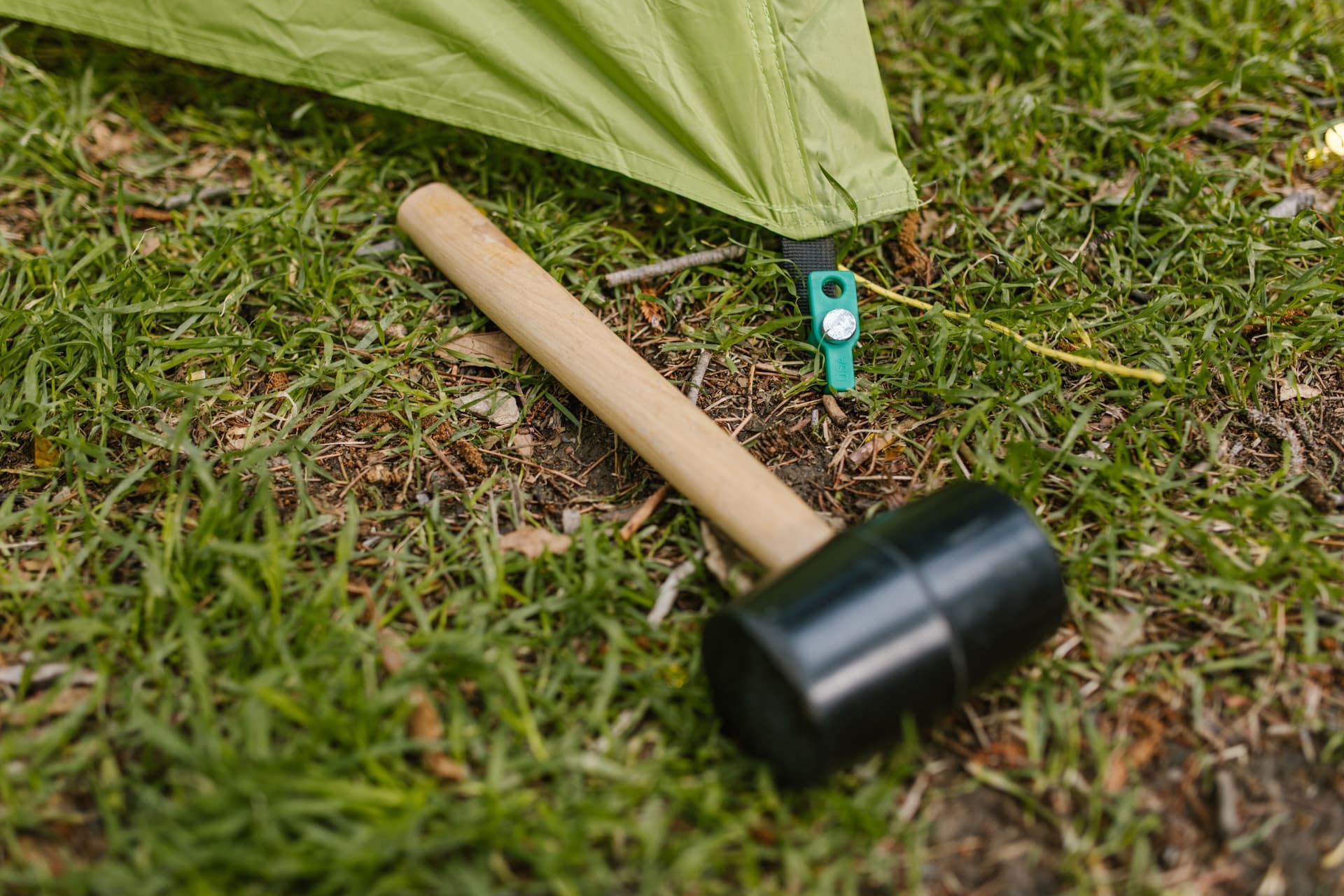
- Drive with a rubber mallet until the bend sits on the tube. Skywalker's are 12.5 in; that whole length should be in the ground.
- One per leg. A 4-pack covers four legs; count yours.
- After a freeze-thaw cycle or a wet week, check that the stakes have not lifted with the soil.
High wind: what changes
Use augers with straps, use all of them, and add a strap kit even on a trampoline that shipped U-stakes. Jumpflex sells its PRO kit specifically for "more exposed settings and even stronger winds," with the disclaimer that it is a preventative measure and not a guarantee, which is the honest position for any anchor. Take the net down and, if a named storm is forecast, take the trampoline down: no anchor is rated for a hurricane. A frame full of leaves or snow adds load; a weather cover is a separate purchase. And note the failure mode: an anchored frame in a big enough gust does not fly away, it folds, so the kit protects the neighbor's car more than it protects the trampoline.
Soft ground, sand and clay
Backyard Discovery's advice for playset stakes applies to trampolines too: anchors need solid soil or clay, not loose soil or sand. In sand, a longer auger and a strap are the only thing that holds; in saturated clay, an auger holds until the clay dries and shrinks around it, so recheck after a dry spell. Artificial turf can be cut and an auger driven through to the base beneath, then the turf laid back. Concrete, pavers and decking cannot take a stake at all; the options are on anchor a trampoline on concrete. In-ground trampolines sidestep the whole problem: in-ground kits.
Kits that fit
Mistakes to avoid
- Anchoring two legs of a six-leg frame. The free legs become the hinge.
- Stakes in loose fill or fresh topsoil. They pull out with two fingers.
- Straps over the net poles instead of the base tube. The poles are the weakest part of the frame.
- Trusting the anchor through a named storm. Take the net down; take the trampoline down if you can.
- Forgetting the trip hazard: CPSC's playground handbook wants anchors buried or covered so nobody catches a foot on them.
How we picked
Scored on paper, and we say so
Most review sites say they tested everything. We didn't test these, and we say so. Every pick is scored from the maker's published specs, manual and warranty terms on a safety rubric we publish (net and edge design, anchoring, rated capacity, standards, install reality), and the sources are listed at the bottom of the page.
Scores are editorial judgments from that published information, not field or lab results. Nobody pays for placement, and an unpublished spec is never guessed upward. See every rubric and weight.
Anchor kits rubric
- Holding design
- 30%
- Fit range
- 20%
- Material & corrosion resistance
- 20%
- Instructions & completeness
- 15%
- Warranty
- 15%
FAQ
Questions parents ask
What is the best way to anchor a trampoline?
How do you anchor a trampoline in high winds?
How many anchors does a trampoline need?
Can you anchor a trampoline on grass?
Do Zupapa and Jumpzylla come with anchors?
Related
Keep reading
Update log
What changed
- First published.
Receipts
Sources
- 1.CPSC Publication 085, Trampoline Safety (PDF; fetched Sep 22, 2026)
- 2.ACON USA: Ground Anchor Kit (2pcs), method and anchor count (checked Sep 22, 2026)
- 3.Skywalker Trampolines: Wind Stakes 4-Pack (checked Sep 22, 2026)
- 4.Jumpflex USA: ANCHORKIT PRO, exposed settings (checked Sep 22, 2026)
- 5.Springfree Trampoline: Ground Anchor, 4 or 8 anchors (checked Sep 22, 2026)
- 6.Backyard Discovery: How to Secure a Swing Set to the Ground, solid soil vs sand (checked Sep 22, 2026)
- 7.Jumpflex USA: HERO 14ft yard space; Jumpzylla size chart clearance (checked Sep 22, 2026)
- 8.CPSC Publication 324, Outdoor Home Playground Safety Handbook, anchoring (fetched Sep 22, 2026)
We don't lab-test trampolines, swing sets or their parts, and we don't pretend to. Capacities, materials, anchoring provisions and warranty terms come from the maker's own listings and manuals (or a named retailer's listing where the maker doesn't publish them). Safety guidance is linked to CPSC, the AAP, ASTM or the study it came from. Prices are set by Amazon and change often, so we don't print them. Where a figure isn't published, we say so. Read the full method.