Install & Anchoring Guide
How Much Space Do You Need for a Trampoline? The Published Clearances, Side and Overhead
A 12 ft trampoline is not a 12 ft problem. Makers publish clearances of 3.3 to 5 ft on every side and, in one case, 27 ft of overhead clearance. Here is how to turn your flat ground into the largest frame it can actually hold.
We may earn a commission when you buy through links on this page, at no extra cost to you. It never decides the ranking: the scoring method is published. How we're funded
What each maker publishes
These are the only real numbers available, and they differ enough to matter.
| Trampoline | Frame footprint | Published space or clearance | Height with enclosure |
|---|---|---|---|
| Jumpflex HERO 14 | 15.1 ft overall diameter; 12.1 ft mat | 15.1 ft plus 3.3 ft clear all around | 8.9 ft |
| Jumpflex FLEX 12 | 13.5 ft overall; 10.5 ft mat | Same 3.3 ft clearance guidance | 8.9 ft |
| Jumpzylla 12 ft | 12 ft diameter; 3.5 ft frame height | 15-17 ft of yard space; 3-5 ft clearance | Not published |
| Jumpzylla 14 ft | 14 ft diameter | 17-19 ft of yard space; 3-5 ft clearance | Not published |
| ACON Air 15 | 15 ft; 15.75 ft with the enclosure fitted | Not published as a figure | 111.8 in (9.3 ft) |
| ACON 16 HD | 17 x 9.8 ft | Not published as a figure | 130 in (10.8 ft) |
| Springfree Jumbo Square S155 | 13 x 13 ft mat; 155 sq ft | 23 x 23 ft required, including 5 ft per side | 9 ft 4 in |
| Springfree Large Oval O92 | 8 x 13 ft mat; 92 sq ft | 18 x 23 ft required | Not published |
| Springfree Medium Round R79 | 10 x 10 ft mat; 79 sq ft | 20 x 20 ft required | Not published |
| Springfree Compact Round R54 | 8 x 8 ft mat; 54 sq ft | 18 x 18 ft required | 7 ft 7 in |
| Skywalker 15 ft round | 15 ft wide | Not published as a figure | 9 ft |
| Vuly Thunder XL | 14 ft 8 in wide; 12 ft 4 in mat | Minimum 27 ft of overhead clearance (US manual) | Not published |
As published by each maker on the product pages and manuals cited below.
Springfree is the most useful brand to plan from, because it publishes a required space for every model rather than a clearance you have to add yourself. Its numbers also show the real ratio: an 8 x 8 ft mat needs an 18 x 18 ft site, so the mat is less than a fifth of the ground the trampoline occupies.
Frame size, mat size and the gap between them
Three different numbers hide behind one label, and people plan with the wrong one.
The label. A "12 ft trampoline" is usually the frame rail diameter, give or take.
The real footprint. Larger than the label once the enclosure, the legs and the pad are counted: Jumpflex publishes 13.5 ft overall on the FLEX 12, and ACON's 15 ft round measures 15.75 ft across with the net fitted.
The usable mat. Smaller than the label: 10.5 ft on the FLEX 12, 12.1 ft on the HERO 14, 12 ft 4 in on the Vuly Thunder XL. If your reason for buying is jumping room, this is the number that matters, and it is the one makers publish least often (what size trampoline).
So a yard that measures 20 ft across takes a 12 ft trampoline comfortably and a 15 ft one only if the clearance can be shaved to the maker's minimum on all four sides, which is not a good trade.
The overhead clearance nobody measures
Enclosure heights run from 7 ft 7 in on the smallest Springfree to 10.8 ft on the ACON 16 HD, and a child jumping adds several feet above the net. Vuly is the only maker in our registry that publishes a figure for the whole envelope, and it is the number worth knowing: a minimum of 27 ft of overhead clearance, stated in the US owner's manual.
In practice that rules out the spot under the big tree, which is also the spot most people choose for the shade. CPSC says to place a trampoline away from structures, trees and other play areas; branches, gutters, washing lines and service drops all sit in the arc. Check it by standing where the frame will go and looking straight up.
How to measure your yard for a trampoline
- Find the flat area, not the lawn. Walk it with a string line and a line level. A frame on a grade loads its downhill legs on every bounce (trampoline on a slope).
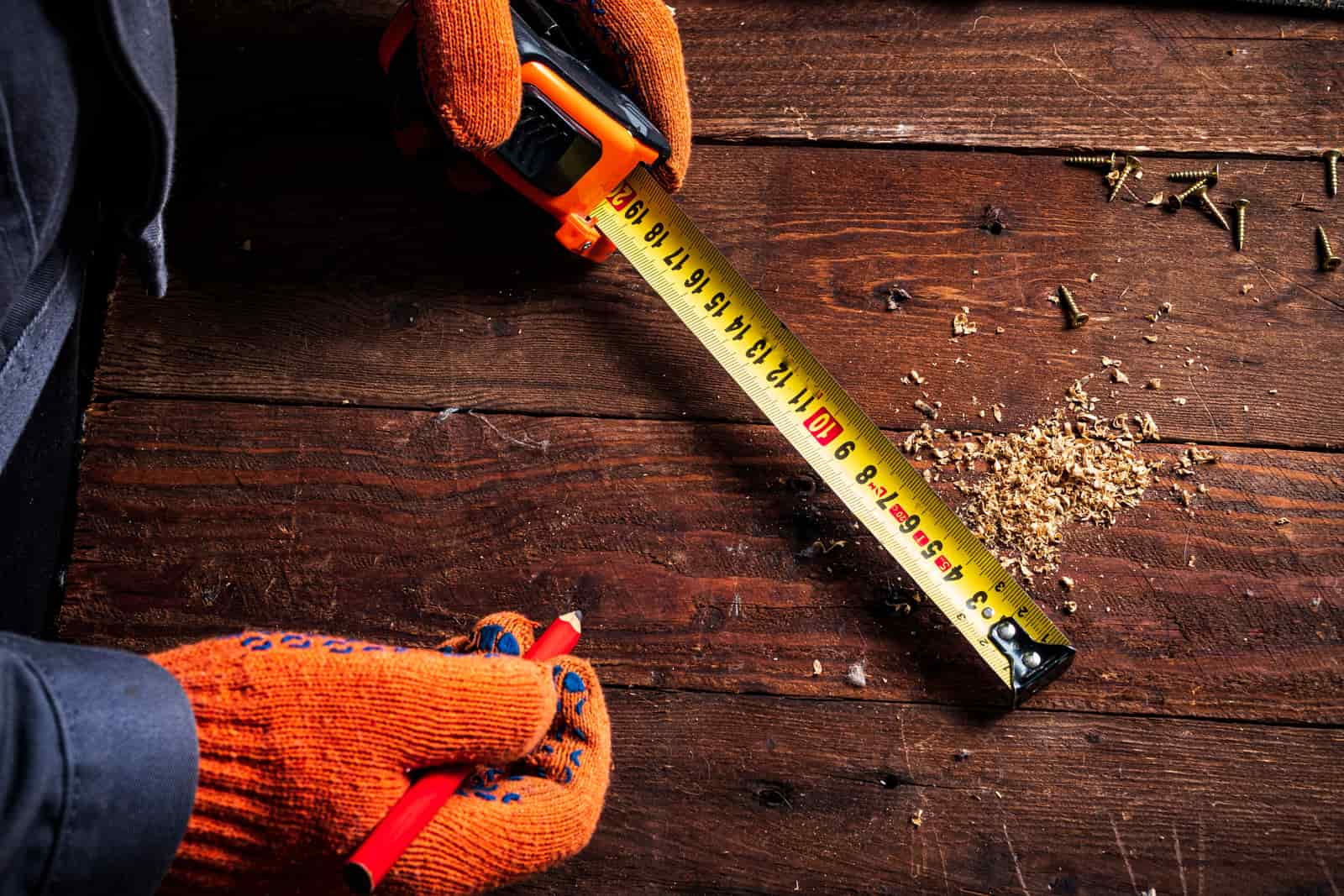
- Mark the frame circle. A stake in the middle and a string half the frame diameter, swung round, gives you the real outline. Use the overall diameter if the maker publishes one, not the label.
- Add the clearance ring. Lengthen the string by the maker's figure, 3.3 to 5 ft, and swing it again. Everything inside that second circle has to be clear: fence, wall, shed, tree trunk, hose reel, patio edge.
- Look up. Branches, wires, eaves and roof overhangs.
- Check the route in. A 15 ft frame arrives in boxes that weigh 335 to 515 lb and has to get through the gate.
- Plan the anchors. Mark where each leg lands and make sure none of them sits on a buried service, a tree root or a soakaway (how to anchor a trampoline).
Narrow, sloped and awkward yards
Long and narrow. This is what ovals and rectangles are for. Springfree publishes 18 x 23 ft for the Large Oval, and a 15 x 9 ft rectangle fits a strip no 15 ft round will go into (round vs rectangle).
Small but square. A 12 ft round in an 18-20 ft clear circle is the standard answer, and the smallest full-enclosure Springfree needs 18 x 18 ft (best 12 ft trampolines).
Sloped. Level a pad; do not shim legs. The clearance ring has to be level too, because that is where a child lands.
No space at all. An in-ground kit removes the fall-from-height problem but not the clearance requirement, and it adds a pit, a retaining wall and drainage (in-ground trampoline cost and installation). A mini or indoor frame is the honest alternative (best indoor trampolines for kids).
Frames for the space you actually have
Three shapes, three different yard problems. Each one publishes the space it needs, which is the reason it is here.
Mistakes to avoid
- Planning from the label rather than the published overall diameter.
- Counting the clearance on three sides because the fourth is a fence.
- Forgetting the overhead line, then pruning a tree in July.
- Siting the frame on the only part of the yard that holds water.
- Using the mat size as the yard requirement; on a Springfree the site is more than four times the mat.
- Buying the largest frame the ground will hold with no margin, which leaves nowhere to walk round it.
How we picked
Why these picks made the list
Every pick is scored from the maker's published specs, manual and warranty terms on a safety rubric we publish (net and edge design, anchoring, rated capacity, standards, install reality), and the sources behind each number are listed at the bottom of the page.
Scores are our editorial judgment of that published information. Nobody pays for placement, and an unpublished spec is never guessed upward. See every rubric and weight.
Trampolines rubric
- Enclosure & edge design
- 30%
- Anchoring provision
- 20%
- Rated capacity & structure
- 20%
- Certification & standards
- 15%
- Install reality
- 15%
FAQ
Questions parents ask
How much space do you need for a trampoline?
How much space does a 12 ft trampoline need?
How much overhead clearance does a trampoline need?
Can a trampoline go next to a fence?
Is the trampoline size the frame or the mat?
What trampoline fits a small or narrow yard?
Related
Keep reading
- What size trampoline do you needSizing from the jumper as well as the yard.
- Trampoline on a slopeWhen the flat area is not flat.
- How to anchor a trampolineOnce the site is chosen.
- Best 12 ft trampolinesThe size most yards can give clearance to.
- In-ground trampoline cost and installationThe other answer to a tight yard.
Update log
What changed
- First published.
Receipts
Sources
- 1.CPSC Publication 085, Trampoline Safety (PDF; fetched Sep 22, 2026)
- 2.Jumpflex USA: HERO 14ft Trampoline, dimensions and clearance (checked Sep 22, 2026)
- 3.Jumpflex USA: FLEX 12ft Trampoline, dimensions (checked Sep 22, 2026)
- 4.Jumpzylla: Premium 14ft Trampoline, yard space and clearance (checked Sep 22, 2026)
- 5.Springfree Trampoline: Jumbo Square (S155), space required (checked Sep 22, 2026)
- 6.Springfree Trampoline: Large Oval (O92), space required (checked Sep 22, 2026)
- 7.Springfree Trampoline: Compact Round (R54), space required (checked Oct 1, 2026)
- 8.ACON USA: ACON Air 15ft Round Trampoline, dimensions (checked Sep 22, 2026)
- 9.Vuly Play: Thunder trampoline US owner's manual, overhead clearance (PDF; checked Sep 24, 2026)
- 10.Skywalker Trampolines: 15' Round Trampoline, dimensions (checked Sep 22, 2026)
Capacities, materials, anchoring provisions and warranty terms come from the maker's own listings and manuals (or a named retailer's listing where the maker doesn't publish them). Safety guidance is linked to CPSC, the AAP, ASTM or the study it came from. Buy buttons open the live Amazon listing, so you always see today's price. Read the full method.