Trampolines Guide
Trampoline Safety Rules: The Nine CPSC Publishes, and How to Make Them Stick
Most trampoline injuries happen to children who are following nobody's rules on equipment nobody checked. Here are the rules CPSC publishes, in CPSC's words, plus the inspection routine and the three parts that let a household keep them.
We may earn a commission when you buy through links on this page, at no extra cost to you. It never decides the ranking: the scoring method is published. How we're funded
The rules, in CPSC's words
CPSC Publication 085 names the causes of trampoline injuries and deaths as colliding with another person on the trampoline, landing improperly while jumping or doing stunts, falling or jumping off, and landing on the springs or frame. Its instructions, quoted:
- "Allow only one person on the trampoline at a time."
- "Do not allow somersaults, because landing on the head or neck can cause paralysis."
- "No child under 6 years of age should use a full-size trampoline."
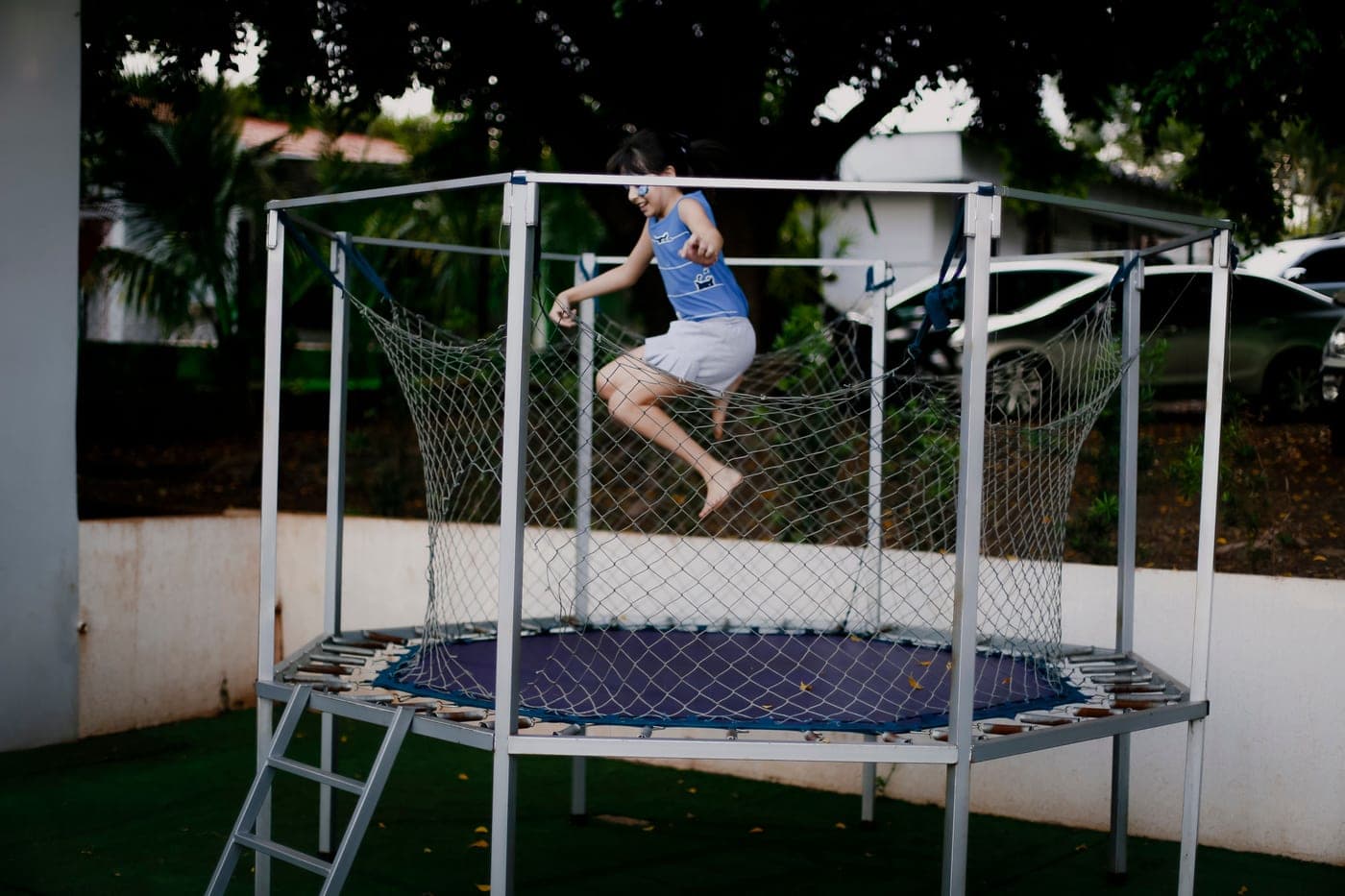
- "Do not use a ladder with the trampoline, because it provides unsupervised access by small children."
- "Always supervise children who use a trampoline."
- "Place the trampoline away from structures, trees and other play areas," on a level surface.
- Keep the springs, hooks and frame covered with protective padding.
- "Trampoline enclosures can help prevent falls off trampolines."
- "Do not use the trampoline without shock-absorbing pads that completely cover its springs."
The American Academy of Pediatrics goes further: its 2012 policy statement strongly discourages home trampoline use, on the grounds that most injuries happen with multiple jumpers on the mat and that safety equipment has not substantially reduced injury rates. That position is worth knowing before you buy rather than after, and it is laid out in full on are trampolines safe for kids.
Why one jumper at a time is the rule that matters
It is first on CPSC's list of causes and first on its list of rules, and it is the rule households break most. The mechanism is physics rather than carelessness: when two children of different weights jump on the same mat, the lighter one gets the stored energy of both, which is how a 40 lb child leaves the mat with force a 40 lb child cannot generate alone. That is the mechanism behind the fracture pattern in the hospital data on trampoline injury statistics.
No product fixes it. A sewn-in net, a thick pad and a 425 lb capacity all make the equipment safer and do nothing about two children colliding. Note also that a maker's headline capacity is not permission: when a listing says four jumpers and CPSC says one, CPSC is describing injuries and the listing is describing a static load test (trampoline weight limits).
Why no somersaults is non-negotiable
CPSC gives the reason in the rule itself: landing on the head or neck can cause paralysis. This is the rule that gets broken at ages 10 to 14, when children can generate enough height to rotate and not enough control to land. A net does not help, because the injury happens on the mat. If a child in the household is going to attempt rotations regardless, that is an argument for a coached facility and for the rectangle frames with even bounce rather than for a backyard round (best trampolines for gymnasts).
The age rule
No child under 6 on a full-size trampoline, in CPSC's words. Makers' own minimums tend to agree: Jumpzylla prints ages 6+ on its frames, and Vuly's US manual states that trampolines over 20 in tall are not recommended for children under 6. For a younger child, the honest alternatives are a ground-level toddler unit with a handle, or no trampoline at all (best trampolines for toddlers, trampoline age recommendation).
The ladder rule nobody follows
CPSC says do not use a ladder, because it gives small children unsupervised access. Most households do use one, because a 35 to 43 in frame height is a real obstacle for a 7-year-old. The compromise that keeps the intent of the rule is a ladder that lifts off and goes somewhere out of reach between sessions, which is also the test we score ladders on (best trampoline ladders). The same reasoning applies to a bolt-on slide, which is a ladder with a better view (best trampolines with a slide).
House rules that actually get followed
CPSC's nine rules are the floor. The version that survives a summer in a real household is shorter, posted where the children see it, and enforced by an adult who is outside rather than watching through a window:
- One on, the rest off. Not negotiable, not by age, not by size.
- No flips, no somersaults, no landing on your head on purpose.
- Shoes off, pockets empty, no toys or balls on the mat.
- Zip the door. A net with an open door is a decoration.
- Nobody under 6 on the full-size frame, including visiting cousins.
- No jumping off, and no climbing the net.
- An adult outside, within earshot and in sight, every session.
- Ladder comes off and goes away when the session ends.
- Nobody on it wet, in the dark, or in wind.
The inspection routine
Rules only hold if the equipment does. Three checks, on a schedule you can actually keep:
Before every session, thirty seconds. Pad in place and covering every spring. Net door closed, no tears, no sagging panels. Nothing on the mat. Nothing underneath the trampoline.
Monthly, five minutes. Walk the frame. Every spring hooked at both ends and none stretched open. Pad fasteners tight and the vinyl not cracked or chalky. Net stitching intact at the mat line, which is where it fails first. Pole foam present and not compacted flat. Anchors still tight in the ground, which they will not be after a wet month.
Each spring, before the first jump of the year. Mat for wear at the stitch lines and V-rings, frame for rust at the welds and leg sockets, and the enclosure net held up to the light: UV-degraded mesh tears at a fingertip long before it looks worn. Replace the net and pad on condition rather than on a schedule, and expect to do it two or three times over the life of a frame (how long trampolines last).
The three parts the rules depend on
Three of CPSC's nine rules are about parts rather than behaviour: pads that completely cover the springs, an enclosure in use, and a trampoline that stays where you put it. Those are buyable, and they are the only part of this page a product can solve.
If the yard is exposed, straight stakes are not enough and a strap-and-auger kit holds more; the full ranking is on best trampoline anchors, and the method is on how to anchor a trampoline.
Mistakes to avoid
- Reading a 450 lb capacity as four children. It is a static load figure.
- Leaving the net door unzipped because it is faster. That removes the one rule a product enforces.
- Supervising from the kitchen window. CPSC says supervise, and every injury mechanism it lists is fast.
- Leaving the ladder up overnight.
- Letting a child under 6 on because an older sibling is watching.
- Anchoring once and never checking. Augers and stakes loosen as the ground moves.
- Keeping a net because it has no visible hole. UV damage is invisible until it tears.
The rule people ask about most, and what the makers themselves publish about it, is on how many kids can jump on a trampoline. Several of these rules also turn up as conditions on a home insurance policy, which is worth knowing before the frame goes up: trampoline insurance requirements.
How we picked
Why these picks made the list
Every pick is scored from the maker's published specs, manual and warranty terms on a safety rubric we publish (net and edge design, anchoring, rated capacity, standards, install reality), and the sources behind each number are listed at the bottom of the page.
Scores are our editorial judgment of that published information. Nobody pays for placement, and an unpublished spec is never guessed upward. See every rubric and weight.
Safety accessories rubric
- Safety design
- 30%
- Fit range
- 20%
- Material & UV resistance
- 20%
- Certification & standards
- 15%
- Install reality
- 15%
Anchor kits rubric
- Holding design
- 30%
- Fit range
- 20%
- Material & corrosion resistance
- 20%
- Instructions & completeness
- 15%
- Warranty
- 15%
FAQ
Questions parents ask
What are the rules for a trampoline?
Why only one person on a trampoline at a time?
Can you do flips on a backyard trampoline?
What age can a child use a trampoline?
Should you remove the trampoline ladder?
How often should a trampoline be inspected?
Related
Keep reading
- Are trampolines safe for kidsCPSC, the AAP and the hospital data in full.
- Trampoline injury statisticsWhat gets hurt, and at what age.
- Trampoline age recommendationThe age rule and the makers' own minimums.
- How to anchor a trampolineThe rule about staying put, done properly.
- Best trampoline safety padsPads that cover every spring.
Update log
What changed
- First published.
Receipts
Sources
- 1.CPSC Publication 085, Trampoline Safety (PDF; fetched Sep 22, 2026)
- 2.CPSC: Trampoline Safety guide page
- 3.American Academy of Pediatrics policy statement, Trampoline Safety in Childhood and Adolescence, Pediatrics 2012;130(4):774-779
Capacities, materials, anchoring provisions and warranty terms come from the maker's own listings and manuals (or a named retailer's listing where the maker doesn't publish them). Safety guidance is linked to CPSC, the AAP, ASTM or the study it came from. Buy buttons open the live Amazon listing, so you always see today's price. Read the full method.