Trampolines Comparison
Zupapa vs Jumpzylla: Which Round Trampoline Is Safer on Paper?
Both put the net inside the springs, curve the poles away and ship something to hold the frame down. One sews the net to the mat and warrants the frame for a decade; the other names the exact US trampoline standard and puts the ladder and anchors in the box.

We may earn a commission when you buy through links on this page, at no extra cost to you. It never decides the ranking: the scoring method is published. How we're funded
Side by side
The picks on each side
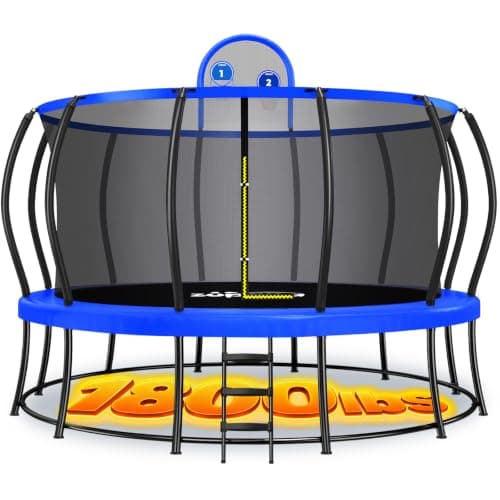
Pick Zupapa for a sewn net and a ten-year frame
Zupapa 15 ft No-Gap Trampoline
8.5 / 10Net and mat are a single sewn piece, poles curve outward under 10 mm foam, wind stakes and tools in the box, TUV and ASTM both named, 10-year frame warranty.
$664.99Amazon#ad · Price as of November 2, 2026 · Affiliate disclosure for the link to Zupapa 15 ft No-Gap Trampoline
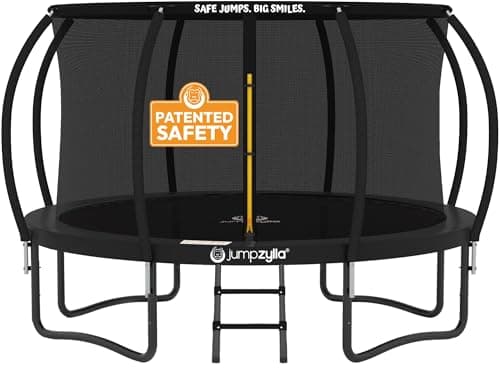
Pick Jumpzylla for the named standard and the complete kit
Jumpzylla Premium 14 ft Trampoline
8.2 / 10ASTM F381-16 by designation, 25 mm closed-cell spring pad, ladder and anchor kit included, 60-90 minute build. The standard warranty runs one year.
$389.95Amazon#ad · Price as of November 2, 2026 · Affiliate disclosure for the link to Jumpzylla Premium 14 ft Trampoline
- ZupapaNo image
Pick Zupapa 12 for a small yard, same design
Zupapa 12 ft Saffun Trampoline
8.5 / 10The sewn net, curved foam poles and included stakes at 12 ft, rated at the same published 425 lb.
Check price on Amazon#ad · Price as of November 2, 2026 · Affiliate disclosure for the link to Zupapa 12 ft Saffun Trampoline
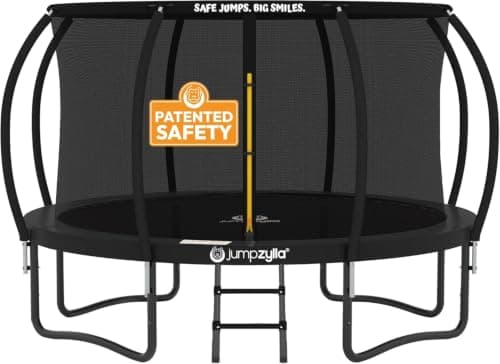
Pick Jumpzylla 12 for a 15-17 ft yard
Jumpzylla Premium 12 ft Trampoline
8.0 / 10Same named certification and in-box ladder and anchors, rated 400 lb, with Jumpzylla's own yard-space figures published.
$329.95Amazon#ad · Price as of November 2, 2026 · Affiliate disclosure for the link to Jumpzylla Premium 12 ft Trampoline
Side by side
As published by each maker on the dates in the source list. Neither brand publishes a separate single-jumper limit.
The net: sewn or triple-layered
Both of these are the design parents should be shopping for: the net goes inside the springs, so the coils and the frame rail sit outside the play area and a child who runs at the enclosure meets fabric rather than steel. That single decision is worth 30 points on our rubric, and it is why both of these outrank every outside-the-frame trampoline on the site. The difference between them is how the net meets the mat.
Zupapa sews it. The enclosure net and the jumping mat are one piece on the No-Gap models, which removes the joint entirely: there is no row of clips to come undone over a season and no gap for a foot to slide into between the mat edge and the net. The practical consequence is that the net cannot be installed wrong; the practical cost is that a torn net means replacing net and mat together. Zupapa publishes a 6 ft net height and 10 mm of foam on poles that curve outward, with long poles that run to the ground rather than stopping at the frame.
Jumpzylla clips, and compensates with material. Its enclosure is a triple-layer netting on outward-curved poles with a zip-and-buckle entry, so the door has two independent fastenings instead of one. It is also the only one of the two that publishes a spring pad thickness: 25 mm of closed-cell foam over the springs, with high-density padding at the edge. Zupapa's product page does not state its pad thickness at all, which is a real gap on the part that takes the worst of the sun. Why pad thickness is the spec that ages fastest, and what to replace it with, is on best trampoline safety pads.
Scored: Zupapa takes 9 on enclosure design for the sewn seam, Jumpzylla 8 for a clipped net with a published pad thickness and a double-fastened door. A tenth of a point either way, and both a long way clear of a net strapped to the outside of the frame.
Certification: a designation or a claim
This is where Jumpzylla pulls ahead, and it is worth understanding why it counts. Most trampoline listings say some version of "ASTM certified", which tells you almost nothing: ASTM publishes thousands of standards, and the claim does not say which one was tested or against which section. Jumpzylla names it. ASTM F381-16 is the consumer trampoline standard covering components, assembly, use and, critically, enclosures. A maker that prints the designation has told you the document it is claiming compliance with, and you can go read it.
Zupapa states TUV certification, which is a German testing house and a real third-party mark, plus a generic ASTM claim. The TUV line is worth more than a bare ASTM sentence, which is why Zupapa still scores 9 here rather than the 7 a generic claim earns on its own. But Jumpzylla scores 10, and it is the only round-spring trampoline in our registry that does. Neither claim is a test result we have verified; both are claims each maker publishes, and that is the honest limit of what this comparison can tell you.
Capacity: two headline numbers
Zupapa publishes 425 lb as the maximum weight capacity for its 12, 14 and 15 ft models. Jumpzylla publishes 450 lb for its 14, 15 and 16 ft models and 400 lb for the 12 ft. Those look like comparable numbers and they are not quite: neither maker separates a single-jumper limit from a structural or static limit, and the single-jumper figure is the one that matters to a 220 lb adult deciding whether to get on.
Jumpzylla makes it harder by stating that the 14 ft suits four jumpers. CPSC's guidance is one person at a time, and the reason is not weight but collision: where more than one child is jumping, it is usually the lighter one who gets hurt. Read the 450 lb as a structural figure, use the trampoline one at a time, and the number stops mattering. Both score 7 on capacity here, and 6 for the 12 ft Jumpzylla where 400 lb covers a smaller mat. The full explanation of why one headline figure is not a weight limit is on trampoline weight limit. If a specific adult needs to be inside a published rating, buy a maker that prints a per-jumper number instead: Zupapa vs Jumpflex covers the one that does.
What is in the box
Jumpzylla ships the frame, mat, springs, spring cover, enclosure, a ladder, an anchor kit and the tools, and publishes a 60-90 minute assembly with a note that one person can manage it. Zupapa ships wind stakes, a spring tool and a self-locking frame that needs no screws, which is the fastest frame assembly in the class; its ladder and basketball hoop are bundle options rather than standard.
Both of those beat the industry norm, which is to sell the anchors separately, and both score 9 on anchoring provision because of it. Two cautions on the contents. First, an included anchor kit is a starting point, not a finish: four stakes in soft or sandy ground do less than an auger set, and the comparison is on best trampoline anchors with the method on how to anchor a trampoline. Second, the ladder is not an unmixed benefit. CPSC says not to use a ladder with a trampoline at all, because it gives small children unsupervised access to a surface they are too young to be on. The honest use is to hook it on for a supervised session and take it off afterwards, and the reasoning is set out on best trampoline ladders.
Yard space is published by both, and it is the number most buyers get wrong. Jumpzylla asks for 17-19 ft of yard for the 14 ft frame and 15-17 ft for the 12 ft, plus 3-5 ft of clearance. Zupapa does not publish a clearance figure on the product page, so use the same arithmetic: frame diameter plus roughly 3 ft on every side, nothing overhead, and no fence or wall in the fall path. The sizing walk-through is on what size trampoline.
Warranty: ten years against one
This is the clearest split on the page and the one most likely to decide it for you. Zupapa publishes ten years on the frame, two years on the mat, pad, net and springs, and lifetime coverage on other accessories. Jumpzylla publishes a standard one-year warranty on all structural parts and materials, with extended and storm coverage sold separately.
A trampoline frame is the part that either lasts a decade or rusts through at the leg welds, and hot-dip galvanizing is what decides it. Zupapa publishes hot-dip galvanized steel with poles up to 1.5 mm thick and W-shaped legs, and then backs it for ten years, which is a maker putting money behind its own corrosion claim. Jumpzylla asks you to pay for that assurance after the first year. If the trampoline is going to live outdoors in a wet or coastal climate and you expect to still own it when the children have outgrown it, the ten-year frame line is worth more than any single spec above it.
Choose Zupapa if / choose Jumpzylla if
- Choose Zupapa if you want the net sewn to the mat so it cannot be assembled wrong, a hot-dip galvanized frame warranted for ten years, TUV certification alongside the ASTM claim, and wind stakes in the box.
- Choose Jumpzylla if you want ASTM F381-16 named by designation rather than claimed, a published 25 mm spring pad, and a ladder plus an anchor kit delivered with the trampoline instead of ordered after it.
- Either way, CPSC's rules decide how safe it actually is: one jumper at a time, no somersaults, nobody under six, and anchored before the first session. Both brands sit in the top group on best trampolines for kids.
Zupapa against the other high-volume round brands is on Zupapa vs Skywalker and Zupapa vs Jumpflex. If the spring-at-the-edge design is what you are trying to avoid altogether, the springless alternative is on Springfree vs spring trampolines, and the two springless brands are compared against each other on Springfree vs Vuly.
Zupapa against the other big-footprint value brand is on Zupapa vs ORCC.
In detail
Every contender, in full
Pick Zupapa for a sewn net and a ten-year frame
Zupapa 15 ft No-Gap Trampoline
Scored on the trampolines rubric
Net and mat are a single sewn piece, poles curve outward under 10 mm foam, wind stakes and tools in the box, TUV and ASTM both named, 10-year frame warranty.
Published specs (tap for source)
- Enclosure & edge design (30%)
- 9
- Anchoring provision (20%)
- 9
- Rated capacity & structure (20%)
- 7
- Certification & standards (15%)
- 9
- Install reality (15%)
- 8
Why we picked it
- Net sewn to the mat, so there is no gap for a foot to slip between net and springs
- Wind stakes are in the box, not a separate purchase
- Both TUV and ASTM certification stated, with a 425 lb published capacity
Worth knowing
- Zupapa publishes one 425 lb figure and does not separate a single-jumper limit from a structural limit
- Spring pad thickness is not published on the product page
- Frame height and net-to-ground clearance are not published on the listing
Skip it if…
…you want a separately published single-jumper limit; Zupapa gives one headline capacity only.
#ad · Price as of November 2, 2026 · Affiliate disclosure for the link to Zupapa 15 ft No-Gap Trampoline
Pick Jumpzylla for the named standard and the complete kit
Jumpzylla Premium 14 ft Trampoline
Scored on the trampolines rubric
ASTM F381-16 by designation, 25 mm closed-cell spring pad, ladder and anchor kit included, 60-90 minute build. The standard warranty runs one year.
Published specs (tap for source)
- Enclosure & edge design (30%)
- 8
- Anchoring provision (20%)
- 9
- Rated capacity & structure (20%)
- 7
- Certification & standards (15%)
- 10
- Install reality (15%)
- 7
Why we picked it
- Only round-spring pick here that names ASTM F381-16 rather than a generic ASTM claim
- Anchor kit and ladder are in the box
- Spring pad thickness (25 mm) actually published
Worth knowing
- Standard warranty is 1 year; longer coverage costs extra
- The '4 jumpers' claim contradicts CPSC's one-jumper guidance; treat 450 lb as a structural figure
- No separate single-jumper limit
Skip it if…
…warranty length matters more to you than box contents; Zupapa and Jumpflex publish 10 years on the frame.
#ad · Price as of November 2, 2026 · Affiliate disclosure for the link to Jumpzylla Premium 14 ft Trampoline
Pick Zupapa 12 for a small yard, same design
Zupapa 12 ft Saffun Trampoline
Scored on the trampolines rubric
The sewn net, curved foam poles and included stakes at 12 ft, rated at the same published 425 lb.
Published specs (tap for source)
- Enclosure & edge design (30%)
- 9
- Anchoring provision (20%)
- 9
- Rated capacity & structure (20%)
- 7
- Certification & standards (15%)
- 9
- Install reality (15%)
- 8
Why we picked it
- Sewn-in net with no gap at the mat edge
- Wind stakes and assembly tools ship in the box
- 10-year frame warranty published
Worth knowing
- Single headline capacity; no separate single-jumper figure
- A 12 ft mat is tight for two older kids jumping together (CPSC says one at a time anyway)
- Spring count for the 12 ft is not stated on the page
Skip it if…
…you have teens or adults who will use it; the published capacity is the same as the 15 ft but the mat is much smaller.
#ad · Price as of November 2, 2026 · Affiliate disclosure for the link to Zupapa 12 ft Saffun Trampoline
Pick Jumpzylla 12 for a 15-17 ft yard
Jumpzylla Premium 12 ft Trampoline
Scored on the trampolines rubric
Same named certification and in-box ladder and anchors, rated 400 lb, with Jumpzylla's own yard-space figures published.
Published specs (tap for source)
- Enclosure & edge design (30%)
- 8
- Anchoring provision (20%)
- 9
- Rated capacity & structure (20%)
- 6
- Certification & standards (15%)
- 10
- Install reality (15%)
- 7
Why we picked it
- Named ASTM F381-16 certification
- Anchor kit and ladder included
- Published yard-space and clearance guidance
Worth knowing
- 1-year standard warranty
- No single-jumper limit published
- Jumpzylla's own chart recommends 12 ft or larger for multiple kids, and CPSC says one at a time
Skip it if…
…you want a long frame warranty without paying for an extension.
#ad · Price as of November 2, 2026 · Affiliate disclosure for the link to Jumpzylla Premium 12 ft Trampoline
How we picked
Why these picks made the list
Every pick is scored from the maker's published specs, manual and warranty terms on a safety rubric we publish (net and edge design, anchoring, rated capacity, standards, install reality), and the sources behind each number are listed at the bottom of the page.
Scores are our editorial judgment of that published information. Nobody pays for placement, and an unpublished spec is never guessed upward. See every rubric and weight.
Trampolines rubric
- Enclosure & edge design
- 30%
- Anchoring provision
- 20%
- Rated capacity & structure
- 20%
- Certification & standards
- 15%
- Install reality
- 15%
FAQ
Questions parents ask
Is Jumpzylla a good trampoline brand?
Is Zupapa better than Jumpzylla?
Do Zupapa and Jumpzylla both come with anchors?
What weight can a Jumpzylla trampoline hold?
Which is easier to put together?
Does either one name a US safety standard?
Related
Keep reading
- Zupapa vs JumpflexThe brand that prints a per-jumper limit.
- Zupapa vs SkywalkerSewn net against a net buttoned at every spring.
- Best trampolines for kidsWhere both brands land against the rest.
- Best trampoline anchorsThe upgrade over four supplied stakes.
- Trampoline weight limitWhy one headline figure is not a per-jumper rating.
Update log
What changed
- First published.
Receipts
Sources
- 1.CPSC Publication 085, Trampoline Safety (PDF; fetched Sep 22, 2026)
- 2.Zupapa: 1500LBS No-Gap Design Trampoline with Safety Enclosure Net product page (checked Sep 22, 2026)
- 3.Zupapa: Saffun 15FT Trampoline With Enclosure Net product page (checked Sep 22, 2026)
- 4.Zupapa: 12FT Outdoor Trampoline With Enclosure Net product page (checked Sep 22, 2026)
- 5.Jumpzylla: Premium 14ft Trampoline product page, size chart and box contents (checked Sep 22, 2026)
- 6.Jumpzylla: Premium 12ft Trampoline product page and size chart (checked Sep 22, 2026)
- 7.Amazon listing: Zupapa No-Gap Design Trampoline with Safety Enclosure, live offer confirmed (checked Oct 7, 2026)
- 8.Amazon listing: Jumpzylla Outdoor Trampoline with Net for Kids, live offer confirmed (checked Oct 7, 2026)
Capacities, materials, anchoring provisions and warranty terms come from the maker's own listings and manuals (or a named retailer's listing where the maker doesn't publish them). Safety guidance is linked to CPSC, the AAP, ASTM or the study it came from. Buy buttons open the live Amazon listing, so you always see today's price. Read the full method.