Trampolines Comparison
Trampoline vs Swing Set: Which One Should You Buy First?
These are not two versions of the same purchase. One has an explicit pediatric recommendation against home use and a one-jumper rule; the other has an installation handbook and a use zone. The age of your kids, the size of your yard and how much supervision you can give decide it.

We may earn a commission when you buy through links on this page, at no extra cost to you. It never decides the ranking: the scoring method is published. How we're funded
Side by side
The picks on each side
Buy the swing set: best all-round pick
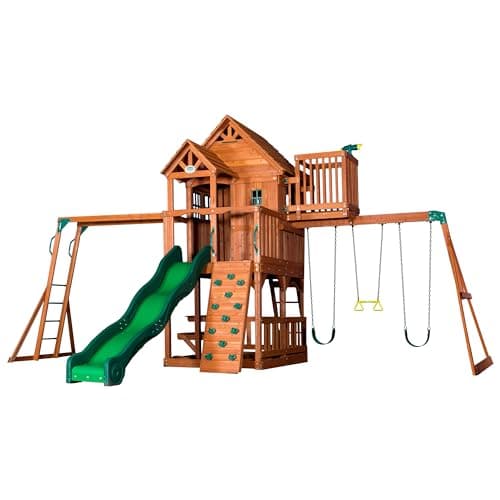
Backyard Discovery Skyfort II Swing Set
7.8 / 10Cedar tower with slide, monkey bars and a clubhouse, ASTM F1148-22 named by code and ground stakes in the box.
$2,499.00Amazon#ad · Price as of November 2, 2026 · Affiliate disclosure for the link to Backyard Discovery Skyfort II Swing Set
- Swing-N-SlideNo image
Buy the swing set: best published limits
Swing-N-Slide Ranger Plus Swing Set
7.8 / 10595 lb total, 300 lb at the beam and six occupants printed, with coated chain and a named standard.
Check price on Amazon#ad · Price as of November 2, 2026 · Affiliate disclosure for the link to Swing-N-Slide Ranger Plus Swing Set

Buy the trampoline: best safety package
Zupapa 15 ft No-Gap Trampoline
8.5 / 10Net sewn to the mat, foam-wrapped curved poles, wind stakes in the box and a published 425 lb capacity.
$664.99Amazon#ad · Price as of November 2, 2026 · Affiliate disclosure for the link to Zupapa 15 ft No-Gap Trampoline
- SpringfreeNo image
Buy the trampoline: no springs at all
Springfree Medium Round Trampoline (R79)
8.2 / 10A 10 ft springless frame with the rods below the jump surface, which removes the spring and frame impact entirely.
Check price on Amazon#ad · Price as of November 2, 2026 · Affiliate disclosure for the link to Springfree Medium Round Trampoline (R79)
What the safety bodies say about each
This is the cleanest difference between the two, and it is the one most comparison articles skip.
On trampolines, CPSC's Publication 085 sets out hard rules: one jumper at a time, no child under 6 on a full-size trampoline, no somersaults, no ladder left against the frame, and supervision by an adult. CPSC estimated 104,691 emergency-room-treated trampoline injuries in 2014. The AAP's policy statement goes further than CPSC and recommends against recreational home trampoline use altogether, and a 2024 peer-reviewed study of 2019 hospitalizations found that fractures accounted for 59.9% of trampoline admissions against 43.8% of other trauma admissions in the same data. You can own a trampoline responsibly, and this site exists to help with that, but there is no reading of the literature in which it is the lower-risk piece of equipment (the injury data in full).
On swing sets, CPSC's approach is different in kind. Publication 324, the Outdoor Home Playground Safety Handbook, is not a warning against owning one: it is an instruction manual for installing one properly. Protective surfacing under and around the equipment, a use zone extending 6 feet in all directions, twice the beam height in front of and behind a swing, guardrails on elevated platforms, and hardware checks on a schedule. Follow the handbook and you have done what the agency asks. There is no equivalent of the AAP position telling families not to own a swing set.
That asymmetry is the honest headline. One product comes with conditions on ownership; the other comes with conditions on installation.
Age is the deciding factor
If your children are under 6, the decision is already made: CPSC's line is that no child under 6 should use a full-size trampoline, and the makers who print an age minimum say the same thing. A toddler-scale trampoline with a sewn-in net and a handlebar is a different product with its own limits, usually 100 lb and one small child (trampoline age recommendations). A swing set, by contrast, scales down cleanly: full-bucket seats, low decks, short slides and coated chains give a two-year-old something to use on the same frame a seven-year-old will climb (best swing sets for toddlers).
From about 6 to 12 the trampoline becomes the thing that actually gets used. Daily, for hours, in a way a swing set generally does not at that age. If your kids are already in that band and the yard will only take one structure, the trampoline is the honest answer, provided you are prepared to enforce one jumper at a time, which is the rule families break first.
Past about 12, a swing set is finished and a trampoline is not: a frame with a 330 lb or higher single-jumper limit carries teenagers and adults (best trampolines for teenagers), where even the heavy-duty swing sets top out at a few hundred pounds across the whole beam (swing set weight limits).
Space: footprint plus use zone
Both need more ground than the box says, and they need it differently.
A 15 ft round trampoline occupies a 15 ft circle, and makers ask for clearance overhead and around it, away from fences, trees, walls and other play equipment, on level ground. In practice that means a clear square roughly 21 to 23 ft on a side for a 15 ft frame if you want a genuine margin on every edge, and a 10 or 12 ft frame is what fits most suburban lots comfortably (how much space a trampoline needs).
A swing set's number is bigger than people expect because the swing arc is part of it: 6 ft of use zone on all sides of the structure, plus twice the height of the swing beam in front of and behind the swings. On a 7 ft beam that is 14 ft fore and aft, so a modest set can want a 25 ft long strip of yard (the swing set safety zone, measured). The difference is shape: a trampoline wants a square, a swing set wants a rectangle. Measure the yard you actually have before you choose, because the shape of your free space may decide this for you.
One footprint cost applies to the swing set and not the trampoline: loose-fill protective surfacing under the equipment, at a depth matched to the fall height. That is a real expense and a real annual task (playground mulch and surfacing). The trampoline's equivalent cost is anchoring, which is cheaper and faster but non-negotiable in wind (how to anchor a trampoline).
Supervision load is not the same
A swing set with four children on it is four children doing four separate things, each one mostly a hazard only to themselves. A trampoline with four children on it is one hazard with four participants, because collision between jumpers of different sizes is the mechanism behind a large share of the serious injuries, and the smaller child is usually the one hurt. CPSC's one-jumper rule is the single most important sentence in trampoline ownership and the hardest to hold at a birthday party.
Put plainly: a swing set can be used while you cook dinner and glance out of the window. A trampoline needs an adult who is actually watching and willing to enforce turns. If that adult is not reliably available, the swing set is the right purchase whatever the children's ages (are trampolines safe for kids).
Lifespan, upkeep and what wears out
A trampoline is a machine with consumable parts. The net, the spring pad and the mat are the wear items, and the published warranties say so: frames carry multi-year terms while nets and pads typically carry one year. Expect to replace a net and a pad at least once in the life of the frame, and plan around a useful life of roughly 8 to 10 years for a well-anchored galvanized frame (how long trampolines last, replacement nets).
A cedar swing set is a structure. Nothing is consumable except the swing seats, chains and hangers, and the upkeep is a finish every few seasons, a hardware check each spring and topping up the surfacing. Cedar sets carry the longest material warranties in this category, and metal sets skip the staining entirely (wooden vs metal swing sets). Against that, a swing set is the harder thing to move house with and the harder thing to sell; a trampoline comes apart into tubes and a mat.
Two swing sets, two trampolines
The four picks below are the ones we would put in a yard on each side of this decision. The two swing sets compare directly on the facts their makers publish:
| Spec | Backyard Discovery Skyfort II Swing Set | Swing-N-Slide Ranger Plus Swing Set |
|---|---|---|
| Capacity | Designed with multiple play areas for up to 15 kids; no weight rating printed | Weight limit 595 lb; maximum 6 occupants; swing beam max weight capacity 300 lb |
| Fall & pinch design | Not published | Plastisol-coated chain prevents pinched fingers and will not rust |
| Anchoring | Ground stakes are included with all Backyard Discovery swing sets, with anchoring instructions | Not published |
| Certification | Engineered to meet or exceed ASTM standards (code F1148-22); residential use only | ASTM and CPSIA compliant; residential use only |
| Size | 263 in W x 201 in D x 148 in H; 709.9 lb | 144 in L x 131 in W x 92 in H |
| Warranty | 5-year warranty | Not published |
The two trampolines take opposite approaches to the same hazard. Zupapa sews the net to the jumping mat so there is no gap, wraps the curved poles in foam, publishes a 425 lb capacity on the 12, 14 and 15 ft models and puts wind stakes in the box. Springfree removes the springs altogether: composite rods sit beneath the mat, the single-jumper limit is 220 lb on the 10 ft R79, the maker asks for a 20 by 20 ft space, and the warranty is 10 years on all parts. Both are credible; which one you want depends on whether you would rather pad the hazard or design it out (springless vs spring trampolines).
Choose a trampoline if / choose a swing set if
Choose a trampoline if every child who will use it is 6 or older; an adult will be outside with them and will enforce one jumper at a time; your free space is a square rather than a strip; and you accept that nets and pads are replaceable parts you will buy again. The trampoline is also the better value per hour of use in that age band, because children choose it over everything else in the yard.
Choose a swing set if any child is under 6; the yard is a long rectangle; supervision will often be from indoors; you want one structure that works for a two-year-old and a nine-year-old at the same time; or you want the purchase with the lower injury profile and the installation-based guidance. A tower playset with a deck adds a slide and a climb, with the extra surfacing work that comes with a fall height (swing set vs playset). For a child too young even for a low deck, a ground-level cottage is the one structure in this category with no fall height at all (best backyard playhouses).
If you are buying both
Keep their use zones separate. CPSC asks for 6 ft of clearance around equipment and for a trampoline to sit away from other play structures, which rules out the common mistake of tucking a trampoline beside the swing arc so that a child swinging can reach it. Give each one its own ground, anchor both, and if the budget only stretches to one structure plus surfacing this year, buy the swing set and the surfacing, and let the trampoline wait until the youngest child clears the age line.
In detail
Every contender, in full
Buy the swing set: best all-round pick
Backyard Discovery Skyfort II Swing Set
Scored on the swing sets & playsets rubric
Cedar tower with slide, monkey bars and a clubhouse, ASTM F1148-22 named by code and ground stakes in the box.
Published specs (tap for source)
- Fall & pinch design (30%)
- 8
- Anchoring provision (20%)
- 9
- Rated capacity & structure (20%)
- 5
- Certification & standards (15%)
- 9
- Install reality (15%)
- 8
Why we picked it
- ASTM F1148-22 named on the listing
- Ground stakes and anchoring instructions in the box
- 10-ft slide with a flat-step ladder for younger kids
Worth knowing
- No weight rating published; 'up to 15 kids' is a play-area count
- A 22 x 17 ft footprint before the 6 ft zone
- 5-year warranty is half Gorilla's lumber term
Skip it if…
…you want a stated capacity in pounds; Gorilla and Swing-N-Slide publish theirs.
#ad · Price as of November 2, 2026 · Affiliate disclosure for the link to Backyard Discovery Skyfort II Swing Set
Buy the swing set: best published limits
Swing-N-Slide Ranger Plus Swing Set
Scored on the swing sets & playsets rubric
595 lb total, 300 lb at the beam and six occupants printed, with coated chain and a named standard.
Published specs (tap for source)
- Fall & pinch design (30%)
- 8
- Anchoring provision (20%)
- 6
- Rated capacity & structure (20%)
- 9
- Certification & standards (15%)
- 8
- Install reality (15%)
- 8
Why we picked it
- Total, per-beam and occupant limits all printed
- Coated chains
- 12 x 11 ft footprint
Worth knowing
- Anchor kit sold separately (Swing-N-Slide Anchor-It)
- 3 in beam is lighter than Gorilla's 4x6
- Simple set: swings and a slide
Skip it if…
…you want a clubhouse; this is a swing beam with a small deck.
#ad · Price as of November 2, 2026 · Affiliate disclosure for the link to Swing-N-Slide Ranger Plus Swing Set
Buy the trampoline: best safety package
Zupapa 15 ft No-Gap Trampoline
Scored on the trampolines rubric
Net sewn to the mat, foam-wrapped curved poles, wind stakes in the box and a published 425 lb capacity.
Published specs (tap for source)
- Enclosure & edge design (30%)
- 9
- Anchoring provision (20%)
- 9
- Rated capacity & structure (20%)
- 7
- Certification & standards (15%)
- 9
- Install reality (15%)
- 8
Why we picked it
- Net sewn to the mat, so there is no gap for a foot to slip between net and springs
- Wind stakes are in the box, not a separate purchase
- Both TUV and ASTM certification stated, with a 425 lb published capacity
Worth knowing
- Zupapa publishes one 425 lb figure and does not separate a single-jumper limit from a structural limit
- Spring pad thickness is not published on the product page
- Frame height and net-to-ground clearance are not published on the listing
Skip it if…
…you want a separately published single-jumper limit; Zupapa gives one headline capacity only.
#ad · Price as of November 2, 2026 · Affiliate disclosure for the link to Zupapa 15 ft No-Gap Trampoline
Buy the trampoline: no springs at all
Springfree Medium Round Trampoline (R79)
Scored on the trampolines rubric
A 10 ft springless frame with the rods below the jump surface, which removes the spring and frame impact entirely.
Published specs (tap for source)
- Enclosure & edge design (30%)
- 10
- Anchoring provision (20%)
- 6
- Rated capacity & structure (20%)
- 7
- Certification & standards (15%)
- 9
- Install reality (15%)
- 8
Why we picked it
- Springless edge in the smallest footprint Springfree makes
- 10-year all-parts warranty
Worth knowing
- Only 79 sq ft of mat
- 220 lb single-jumper limit
- Anchors extra
Skip it if…
…two kids will want to jump; the 10 ft mat is a one-at-a-time surface.
#ad · Price as of November 2, 2026 · Affiliate disclosure for the link to Springfree Medium Round Trampoline (R79)
The cost shape of each, without numbers
A trampoline is mostly a one-off purchase with a small recurring tail: anchors up front, then a net and a pad somewhere in years three to six. A swing set front-loads differently: the structure, plus surfacing across the whole use zone, which is the line item families forget and which scales with the fall height rather than with the price of the set. Check the current price on both before you decide, because the gap between the two categories moves with the season and with the size you are looking at.
Moving house, and resale
If you expect to move within a few years, this matters more than the play value. A trampoline disassembles into a stack of tubes, a mat and a net, fits in a van and goes back up in an afternoon. A cedar tower playset is a day of dismantling, a lot of hardware, and panels that do not always survive the trip. Metal and maintenance-free sets travel better than cedar ones.
The rules that actually prevent injuries
On a trampoline: one jumper, no somersaults, no child under 6 on a full-size frame, net zipped, ladder put away so a toddler cannot climb up unsupervised, and anchors checked after storms. On a swing set: surfacing at the right depth and raked level, 6 ft clear around the structure and twice the beam height front and back, hardware and hangers checked each spring, and nothing hanging from the frame that was not designed for it. Both lists are short, and neither is optional (trampoline safety rules, swing set safety standards).
How we picked
Why these picks made the list
Every pick is scored from the maker's published specs, manual and warranty terms on a safety rubric we publish (net and edge design, anchoring, rated capacity, standards, install reality), and the sources behind each number are listed at the bottom of the page.
Scores are our editorial judgment of that published information. Nobody pays for placement, and an unpublished spec is never guessed upward. See every rubric and weight.
Swing sets & playsets rubric
- Fall & pinch design
- 30%
- Anchoring provision
- 20%
- Rated capacity & structure
- 20%
- Certification & standards
- 15%
- Install reality
- 15%
Trampolines rubric
- Enclosure & edge design
- 30%
- Anchoring provision
- 20%
- Rated capacity & structure
- 20%
- Certification & standards
- 15%
- Install reality
- 15%
FAQ
Questions parents ask
Is a trampoline or a swing set better for kids?
Which is safer, a trampoline or a swing set?
Which needs more space, a trampoline or a swing set?
Can you put a trampoline next to a swing set?
Which lasts longer, a trampoline or a swing set?
If we can only buy one this year, which should it be?
Related
Keep reading
Update log
What changed
- First published.
Receipts
Sources
- 1.CPSC Publication 085, Trampoline Safety (PDF; fetched Sep 22, 2026)
- 2.CPSC Publication 324, Outdoor Home Playground Safety Handbook (PDF; fetched Sep 22, 2026)
- 3.American Academy of Pediatrics policy statement, Trampoline Safety in Childhood and Adolescence, Pediatrics 2012;130(4):774-779
- 4.Totapally et al., Pediatric Hospitalization Due to Trampoline-Related Injuries in the United States During 2019, Cureus, Dec 2024 (PMC11687177; fetched Sep 22, 2026)
Capacities, materials, anchoring provisions and warranty terms come from the maker's own listings and manuals (or a named retailer's listing where the maker doesn't publish them). Safety guidance is linked to CPSC, the AAP, ASTM or the study it came from. Buy buttons open the live Amazon listing, so you always see today's price. Read the full method.